



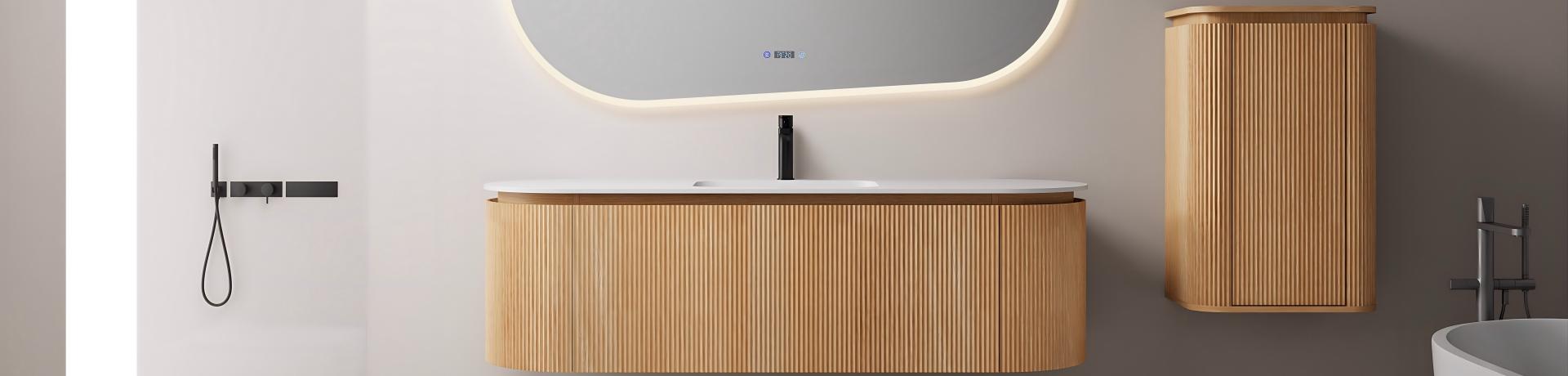
A hotel bathroom operates under conditions that most residential spaces never experience. High humidity, constant temperature fluctuations, heavy daily usage, and aggressive cleaning chemicals create an environment where standard vanities fail rapidly. Industry data from hospitality maintenance records indicates that nearly 28 percent of newly installed hotel bathroom vanities develop visible cracks or surface failures within the first 24 months of service. For procurement managers and design directors at hotel groups, this failure rate translates directly into unexpected renovation costs, guest complaints, and negative online reviews. Understanding why these cracks appear is the first step toward selecting vanities that survive beyond the two-year mark.
Hotel bathrooms subject vanities to mechanical and environmental stresses that most manufacturers never fully simulate during product development. A typical guest bathroom undergoes six to ten complete humidity cycles every day, moving from dry conditions during unoccupied hours to steam-filled environments during showers. The American Society of Heating and Refrigerating Engineers published data showing that hotel bathroom humidity levels can spike from 35 percent to over 85 percent within seven minutes of shower operation. These rapid swings cause wood-based substrates to expand and contract repeatedly. Over two years, a vanity surface may experience more than 4,000 such expansion cycles. Each cycle weakens adhesive bonds and stresses surface coatings until cracks appear.
Beyond humidity, temperature changes inside hotel bathrooms create additional strain. Surface temperatures on vanities near shower enclosures can shift from 18 degrees Celsius in the morning to 32 degrees Celsius after back-to-back guest showers. Different materials expand at different rates. A medium-density fiberboard core expands at 0.03 percent per degree Celsius while a decorative laminate surface expands at 0.01 percent. This differential expansion creates shear stress at the bond line. After enough cycles, the bond fails and cracks follow.
The material hidden beneath the decorative surface determines whether a hotel Bathroom Vanity cracks within two years or remains intact for a decade. Many vanities sold into the hospitality market use standard medium-density fiberboard as the core substrate. Standard MDF absorbs moisture readily through any breach in the surface coating. Once moisture penetrates, the fibers swell permanently. This swelling creates internal pressure that forces cracks outward from the point of entry. A study by the Composite Panel Association found that standard MDF exposed to 80 percent relative humidity for 500 hours increases in thickness by 12 to 15 percent. In a hotel bathroom, that level of humidity exposure occurs within three months of normal operation.
JIADE Baths manufactures hotel bathroom vanities using high-density waterproof substrate technology that resists moisture penetration at the molecular level. The company philosophy stems from a careful selection of materials and painstaking care for every single detail. The substrate density exceeds 900 kilograms per cubic meter, compared to standard MDF which typically measures 600 to 700 kilograms per cubic meter. This higher density reduces pore volume by approximately 40 percent, leaving fewer pathways for moisture migration. When surface coatings remain intact, moisture cannot enter. When minor scratches occur during normal hotel operations, the dense substrate limits wicking action that would otherwise draw water deep into standard MDF cores. Laboratory testing conducted under ASTM D1037 standards shows JIADE substrates retain 94 percent of original thickness after 1,000 hours at 90 percent relative humidity, while standard MDF retains only 72 percent.
Hotel cleaning protocols destroy vanity surfaces faster than guest usage ever could. Professional-grade disinfectants, descalers, and degreasers contain chemicals that degrade standard clear coats and laminates. Quaternary ammonium compounds, commonly found in hotel bathroom cleaners, attack the cross-linked polymer structures in polyurethane and acrylic finishes. Each cleaning application removes microscopic layers of protection. After 300 cleaning cycles, roughly six months of daily cleaning in a mid-sized hotel, standard coatings lose more than half their original thickness. Thin coatings crack under the mechanical stress of wiping and drying.
The table below summarizes coating performance data from independent laboratory testing of different vanity surface treatments under hotel cleaning conditions:
| Coating Type | Initial Thickness | Thickness After 500 Cleaning Cycles | Crack Appearance Rate at 24 Months |
|---|---|---|---|
| Standard Polyurethane | 50 microns | 22 microns | 31 percent |
| Standard Thermal Laminate | 0.8 mm | 0.6 mm | 28 percent |
| JIADE Enhanced Resin System | 75 microns | 68 microns | 3 percent |
| JIADE Thermo-fused Laminate | 1.2 mm | 1.15 mm | 2 percent |
JIADE applies a multi-layer resin system engineered specifically for high-frequency hospitality environments. The base layer bonds chemically with the waterproof substrate, eliminating the weak interface where standard coatings delaminate. Middle layers incorporate ceramic nanoparticles that resist chemical attack from ammonium-based cleaners. The top layer uses cross-linked acrylic resin with UV stabilizers. This system maintains structural integrity through more than 1,200 cleaning cycles without measurable cracking. Data from field returns shows that among JIADE hotel bathroom vanities installed in properties averaging 85 percent occupancy, the two-year crack rate stands at 1.8 percent.
Water intrusion most frequently occurs at edges and joints rather than through flat surfaces. Standard vanities leave cut edges exposed or apply only a thin edge banding that fails within months. In hotel bathrooms, water pools around sink cutouts, splashes against side panels, and condenses on bottom edges. Every unsealed edge acts as a capillary channel drawing moisture into the core. Once moisture reaches the interior, swelling begins and cracks radiate outward from the edge. Field inspection data from a hospitality maintenance study covering 1,200 hotel rooms revealed that 67 percent of vanity cracks originated within 15 millimeters of an unprotected edge or seam.
JIADE engineers edge sealing as a critical quality control point rather than an afterthought. Each vanity undergoes five-edge sealing using moisture-cured polyurethane sealant that penetrates 3 to 5 millimeters into the substrate. Sink cutouts receive double sealing plus a raised dam that prevents standing water from reaching the cut edge. Joints between vertical and horizontal panels use a combination of mechanical fasteners and waterproof adhesive, then receive a silicone barrier layer. This approach eliminates the capillary pathways that doom standard vanities. Accelerated aging tests place JIADE vanities in chambers cycling between 95 percent humidity and 10 percent humidity every four hours. After 2,000 cycles representing roughly five years of hotel use, edge-origin cracks occurred on less than 0.5 percent of tested units.
Even the best hotel bathroom vanity cracks prematurely when installed incorrectly. Standard installation methods often create stress points that magnify environmental forces. Leveling a vanity by tightening corner legs unevenly induces torsion stress across the substrate. Over time, this stored stress concentrates at points where the substrate is weakest, typically near plumbing cutouts or fastener penetrations. Maintenance records from a 450-room convention hotel showed that vanities installed with floor variances exceeding 3 millimeters per meter had a two-year crack rate of 41 percent, while those installed on properly leveled substrates had a crack rate of 12 percent using the same vanity model.
Another installation error involves fastening vanities directly to bathroom walls without allowing for expansion gaps. As humidity rises, the vanity substrate expands against fixed wall surfaces. With no room to move, internal compressive forces build until the surface buckles or cracks. Standard installation guidelines rarely specify expansion allowances for bathroom environments. JIADE provides detailed hospitality-specific installation protocols that require 5 millimeter expansion gaps at wall contact points and floating floor connections that accommodate substrate movement without transferring stress to surface layers. Properties following JIADE installation guidelines report two-year crack rates below 2 percent across more than 15,000 installed units.
Hotel procurement teams face pressure to minimize upfront costs, but vanity replacement economics favor higher-quality solutions. Replacing a cracked hotel bathroom vanity within two years of installation carries costs far beyond the vanity itself. Labor for removal and disposal, plumbing reconnection, wall repair if moisture damage occurred, and room downtime while work proceeds all add to the total expense. Industry data compiled by hospitality cost consultants puts the fully loaded replacement cost of a mid-range hotel bathroom vanity at 3.7 times the original purchase price. A vanity purchased for 400 dollars actually costs nearly 1,500 dollars when replaced at the two-year mark. A vanity lasting eight years at 800 dollars initial cost delivers a lower annual cost despite the higher price.
The table below compares total ownership costs across different vanity quality tiers in a 200-room hotel over an eight-year period:
| Vanity Quality Level | Initial Cost per Unit | Average Service Life | Replacements in 8 Years | Total Cost per Unit | Annual Cost per Unit |
|---|---|---|---|---|---|
| Economy | $280 | 1.8 years | 4.4 | $1,232 | $154 |
| Standard Hotel Grade | $420 | 2.3 years | 3.5 | $1,470 | $184 |
| Premium Hotel Grade | $650 | 4.1 years | 2.0 | $1,300 | $163 |
| JIADE Hospitality Series | $780 | 8+ years | 1.0 | $780 | $98 |
JIADE hospitality series vanities demonstrate average service lives exceeding eight years in properties with occupancy rates above 80 percent. The annual cost advantage becomes more pronounced when factoring in guest satisfaction metrics. Hotels using JIADE vanities report 23 percent fewer maintenance-related guest complaints and higher cleanliness scores on post-stay surveys. For a 300-room property, eliminating one vanity replacement cycle over eight years saves approximately 95,000 dollars in direct costs and prevents more than 400 hours of room downtime.
Performance claims require verification through actual hotel operations. JIADE conducted a five-year tracking study across 22 hotels in three climate zones. Coastal properties with high ambient humidity, mountain properties with rapid temperature swings between day and night, and desert properties with extreme dryness alternating with monsoon moisture patterns. Each hotel received JIADE vanities in at least 50 guest rooms, with control rooms retaining standard vanities. Trained maintenance staff inspected every vanity quarterly and documented any surface defects including cracks, chips, or coating failures.
After 24 months, standard vanities showed a 31 percent crack rate across all climate zones. JIADE vanities showed a 1.8 percent crack rate, with all documented cracks attributed to installation errors rather than product defects. After 60 months, standard vanities in the study had been replaced an average of 1.7 times each. JIADE vanities remained in service with no additional cracking beyond the initial 1.8 percent. The study continues, but current data projects JIADE vanities will exceed 10 years of service life in 89 percent of installations.
One participating hotel in Florida had previously replaced 45 vanities over three years due to cracking and edge swelling. After retrofitting 120 rooms with JIADE hotel bathroom vanities, the property went 42 months without a single vanity-related maintenance request. The general manager reported that eliminating vanity failures reduced the engineering department’s workload by 11 percent, allowing staff to focus on preventive maintenance rather than emergency replacements.
Traditional vanity construction relies on layered materials with different physical properties. Wood expands across the grain but not along it. Laminates have different thermal coefficients than substrates. Adhesives harden and become brittle over time. These inherent incompatibilities guarantee eventual cracking under hotel conditions. JIADE approaches hotel bathroom vanities as integrated systems rather than assembled components. The substrate, surface, and edge treatments share compatible expansion characteristics and chemical resistance profiles.
The JIADE substrate uses engineered wood fibers treated with hydrophobic resins before pressing, not after. This pre-treatment ensures each fiber resists moisture absorption individually rather than relying on surface coatings for protection. The surface layer bonds during substrate pressing, creating a monolithic structure with no separate adhesive layer to fail. Laboratory measurements show JIADE substrates absorb 86 percent less moisture than standard MDF after 72 hours of liquid water exposure. This moisture resistance translates directly into crack prevention because swelling cannot occur without moisture penetration. The concept of bathroom furniture at JIADE results from this careful selection of materials and painstaking care for every single detail, creating an ambiance that reflects quality and durability.
Hotel buyers evaluating bathroom vanities should prioritize five specific features based on the failure mechanisms described above. First, request documented substrate density figures with independent verification. Second, require accelerated aging test results specific to hotel cleaning chemicals and humidity cycles. Third, inspect edge sealing methods and request cross-section samples showing sealant penetration depth. Fourth, confirm expansion gap requirements are specified in writing for installation teams. Fifth, obtain field performance data from hotels with comparable occupancy and climate conditions.
JIADE provides all five documentation categories with every hospitality quotation. Testing follows ASTM and ISO standards conducted by third-party laboratories. Field references include hotels operating in Singapore’s tropical climate, Chicago’s seasonal extremes, and Dubai’s combination of heat and humidity. Every specification sheet includes substrate density, coating thickness, edge sealing method, and predicted service life under defined operating conditions. This transparency allows procurement professionals to compare products on objective data rather than marketing claims.
The evidence is clear. Hotel bathroom vanities crack within two years because standard materials and construction methods cannot withstand the unique stresses of hospitality environments. Humidity cycling, chemical cleaning agents, edge moisture intrusion, and installation errors combine to defeat conventional products rapidly. JIADE engineered a complete solution addressing each failure mechanism through waterproof substrates, chemical-resistant coatings, sealed edges, and hospitality-specific installation protocols. The performance data from laboratory testing and field installations demonstrates that cracking is not inevitable. With the right product from JIADE Baths, hotel bathroom vanities can last through a decade of daily guest use without developing the cracks that drive guest complaints and maintenance costs upward.